

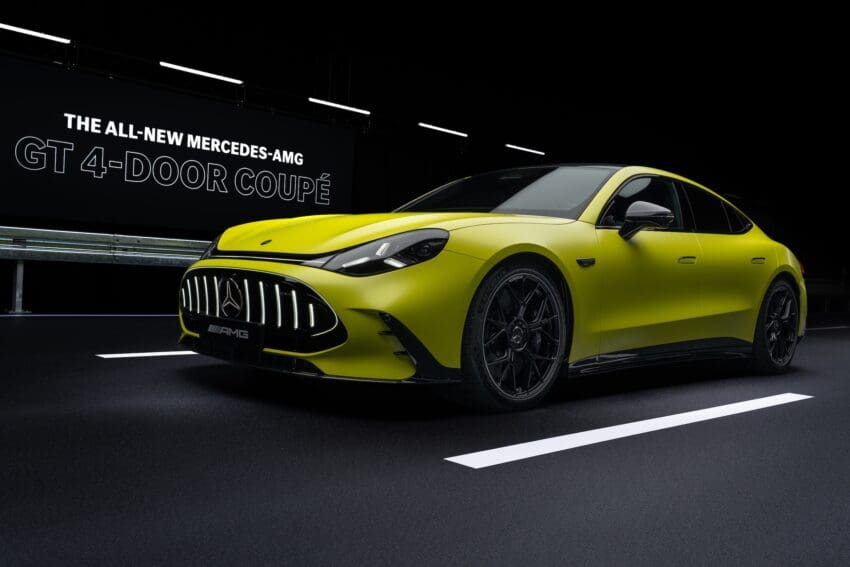
Mercedes-AMG Enters the Electric Era with the 2027 GT 4-Door Coupe
There are moments in the history of a great automotive brand that feel genuinely significant — not just as product launches, but as statements of intent. The unveiling of the 2027 Mercedes-AMG GT 4-Door Coupe is one of those moments. It is the car that AMG has staked its entire electric future on, and having lived in the shadow of its own combustion-engined legacy for decades, the pressure to get it right could not have been greater.
The verdict? Stuttgart has swung for the fences — and very nearly cleared them entirely.
The Numbers That Make You Blink
Let’s start where AMG has always wanted you to start: the performance figures. The GT 4-Door Coupe is offered in two configurations, the GT55 and the range-topping GT63, and it is the latter that carries the headline numbers that will make even the most hardened petrolhead pause for a moment. Three axial-flux electric motors — a configuration borrowed from the world of motorsport engineering — produce a combined 1,153 horsepower and a frankly staggering 1,475 lb-ft of torque. The sprint from standstill to 60 mph takes just two seconds flat with launch control engaged, making it quicker off the line than almost anything with a number plate. Top speed is electronically limited to 186 mph.
Those figures aren’t just impressive in isolation — they represent the most powerful production car Mercedes-AMG has ever built. A company that built its entire identity on thunderous V8 and V12 power has just surpassed everything it ever produced with electrons.
The more accessible GT55 is no slouch either, with 805 horsepower and a 2.7-second zero to sixty time that would have been considered hypercar territory just a few years ago.
The AMG.EA Platform: Engineering at Its Most Ambitious
Underpinning all of this is something genuinely new — the AMG.EA platform, developed specifically for this car and this purpose. AMG has not simply dropped an electric powertrain into an existing chassis and called it a day. This is a ground-up rethinking of what a performance car can be, built around the specific demands of axial-flux motor technology and a 106 kWh battery pack that has been engineered with the kind of attention to thermal management you would expect from a racing programme.
Each of the 2,660 individual battery cells is directly cooled by a specially developed non-conductive oil flowing around them, ensuring consistent temperature across the entire pack whether you are crawling through city traffic or attacking a racetrack. It is a system that prioritises performance under sustained load — because AMG’s customers do not buy these cars to drive gently.
Charging capability is equally ambitious. The car supports up to 600 kilowatts of DC fast charging, capable of taking the battery from 10 to 80 percent in as little as eleven minutes. The honest caveat is that the charging infrastructure to support that speed is still catching up with the technology — but as a statement of what is possible, it sets a remarkable benchmark.
The Question Every AMG Customer Was Asking
Here is where it gets interesting, and where AMG has had to do some of its most careful thinking. The customers who buy a GT63 do not just want speed — they want an experience. They want the drama of acceleration felt in their chest, the soundtrack that turns heads on a Sunday morning run, the sense that something genuinely mechanical and alive is happening beneath them. An electric motor, however powerful, is by its nature quiet. That silence has been the great unspoken challenge for every performance brand making this transition.
AMG’s answer is a system called AMGFORCE — a technology that generates what the company describes as an authentic V8 sound signature combined with haptic feedback through the steering wheel and seat, calibrated to respond to throttle inputs, cornering forces and driving mode. It is, in its own way, a fascinating admission: that the emotional experience of driving a great car is not entirely separable from what you hear and feel, and that engineering those sensations artificially is a perfectly legitimate way to preserve them.
Whether it will satisfy the most devoted AMG faithful is a question that only seat time will truly answer.
A Car That Refuses to Be Subtle
It would be remiss not to address the design, which has proven to be the most divisive element of the entire package. The GT 4-Door Coupe is not a shy car. Its steeply raked fastback roofline and dramatically sculpted body make a bold, confident statement, and active aerodynamic elements — including a deployable rear spoiler — give it a purposeful, almost aggressive stance when the driving mode demands it.
Opinion has been divided. Some see it as a thrilling, futuristic piece of design that signals exactly how seriously AMG takes this new chapter. Others have found the front end, with its distinctive illuminated treatment, rather more polarising than they would like from a car at this price point. In truth, few great performance cars have arrived without controversy — and the history of the AMG GT itself suggests that the design tends to grow on people once they have spent time in its company.
Legacy Preserved, Future Embraced
What makes the GT 4-Door Coupe genuinely admirable is the confidence with which AMG has committed to it. This is not a hedge or a half-measure. It is a full-blooded, no-compromises performance car that happens to be electric — and in doing so it sets a new benchmark for what the format can achieve.
AMG has spent decades building a reputation on the idea that performance is something you feel as much as measure. The challenge it has set itself with this car is to prove that electricity can deliver that feeling just as completely as a four-litre twin-turbocharged V8 ever did. Based on the evidence, it has come closer to that goal than almost anyone expected.
The beast has gone quiet. But it has never been faster.
Comments are closed